Concept Ebook
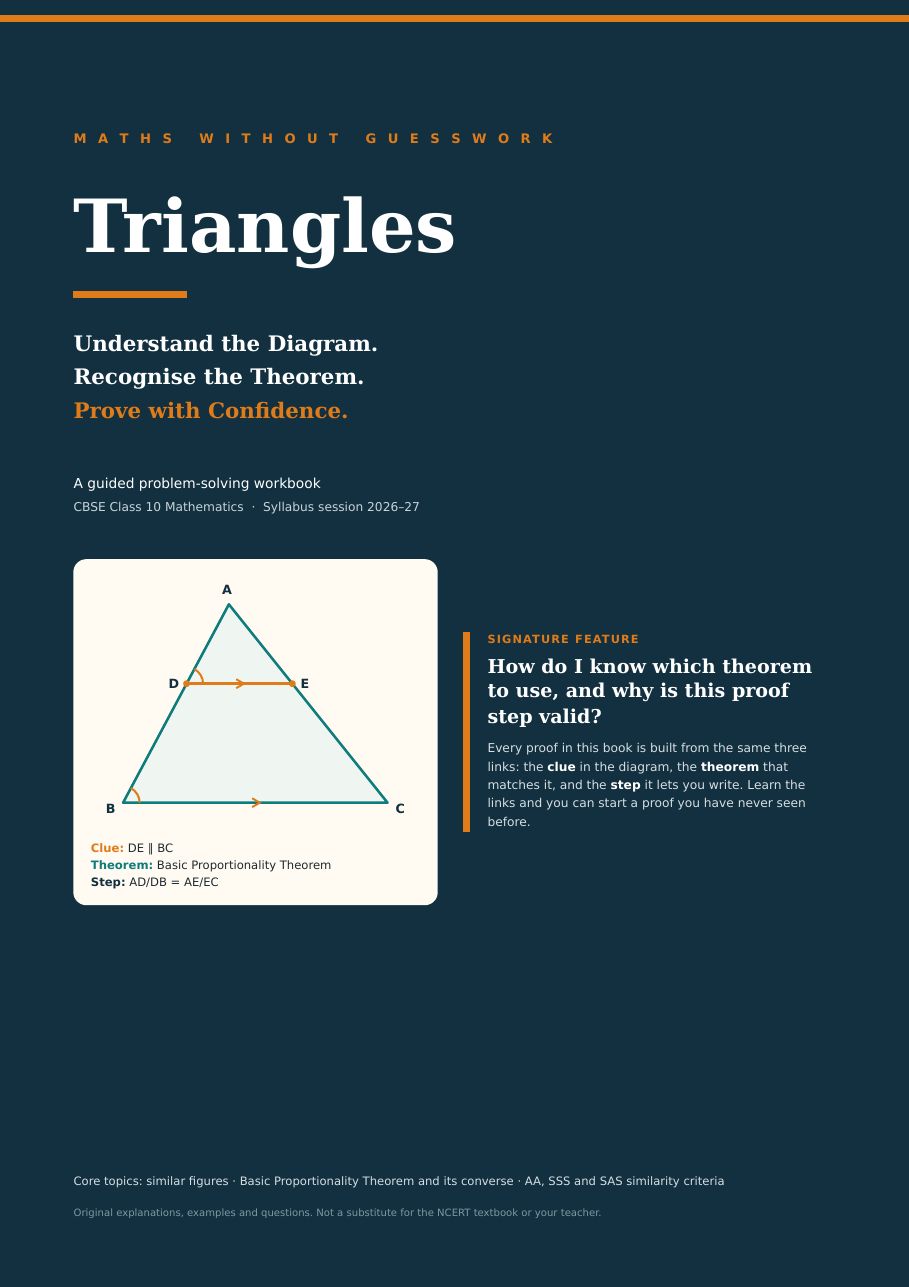
Triangles
Understand the Diagram. Recognise the Theorem. Prove with Confidence.
Triangles is a proof chapter. Students often know the Basic Proportionality Theorem and the similarity criteria by name, but can’t tell which one a diagram is pointing to, or why a proof step is valid.
This workbook connects the clue in the diagram, the matching theorem and the logical step. You see each theorem first, then prove it, then use it in questions that look different from the examples.
₹99
Buy now · ₹99 Open the free sample (PDF)Need every chapter? Get all 14 workbooks for ₹999.
Secure payment by Razorpay. If an ebook doesn’t reach you, we’ll resend it.
Is this workbook for you?
It is written for students who recognise themselves in any of these:
- You can state BPT but don’t know when to use it.
- You confuse AA, SSS and SAS similarity.
- You write proofs but lose marks for missing reasons.
- You find it hard to see similar triangles inside a complicated diagram.
What you will learn
- Understand similar figures, with examples and counter-examples
- See and prove the Basic Proportionality Theorem
- Use BPT to find lengths
- Use the converse of BPT to prove lines are parallel
- Use the AA, SSS and SAS similarity criteria, and recognise them in proofs
- Use similarity to find sides and angles
What is inside
Everything listed here is in the Triangles PDF.
- Diagnostic challengeA short warm-up to find what you already know before you start.
- FoundationConcept explanations that build the ideas the chapter depends on.
- Core theoremsWorked examples with a reason for every step, and quick checks to try.
- Doubt Bank16 common doubts answered clearly, each followed by a question to try.
- Theorem selectionClue tables, decision charts and look-alike questions that train you to choose the method.
Show all 9 sections
- Mistake Clinic9 common mistakes: the wrong work, why it is tempting, and the fix.
- Practice36 graded practice questions, from guided to unfamiliar.
- Answer keyFull explanations for every question, kept separate from the questions.
- RevisionA revision sheet to recap the whole chapter.
Practise this chapter for the board exam
Board Booster
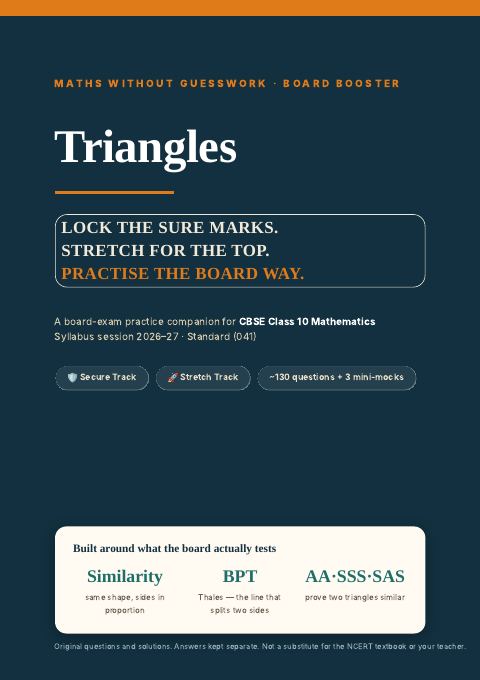
Triangles Board Booster
Once the chapter makes sense, practise it in the board’s own question formats: 130 questions, 3 timed mini-mocks and a full Answer Key.
Chapter combo
Want both for this chapter? Concept ebook ₹99 + Board Booster ₹99 = ₹198. Combo price ₹149: you save ₹49. You receive both PDFs.
Buy both · ₹149Sample pages
9 real pages from the workbook. Tap a page to read it full size, or open the free sample PDF — no sign-up needed.
Prefer it emailed to you?
Product details
- Format
- PDF (A4, portrait)
- Length
- 50 pages + cover
- File size
- about 1.5 MB
- Language
- English (simple, student-friendly)
- Syllabus
- CBSE Class 10 Mathematics, syllabus session 2026–27
Prepared for the CBSE 2026–27 syllabus session, as stated in the workbook. Syllabi can be revised, so check the latest CBSE circular. - Devices
- Phone, tablet, laptop or desktop with any PDF reader
- Printing
- You may print the PDF for your own personal study.
- Licence
- Each purchase is for one student or one household. Please don't share, upload or resell the file.
How you receive it
- Download straight awayAs soon as your payment is confirmed, a Download button appears on your confirmation page.
- Link also sent by emailWe email you the same download link, in case you’d rather download later or on another device.
- Save the PDF straight awayYour download link works once for each ebook. Lost the file later? Download it again from My ebooks with the email you paid with.
Questions about this workbook
Is it written for the 2026–27 CBSE syllabus?
Yes. The workbook is prepared for the CBSE Class 10 Mathematics syllabus session 2026–27 and says so on its cover. Topics outside the current syllabus are left out or clearly marked as enrichment.
Are the answers included?
Yes. The answer key explains every question, and it is kept separate from the questions so students attempt first and check after.
Can my child use it without a tutor?
It is written so a student can work through it alone, with the same labels on every page and a reason for every step. It supports school teaching and the NCERT textbook, and does not replace them.
More Class 10 Mathematics workbooks
Concept Ebook
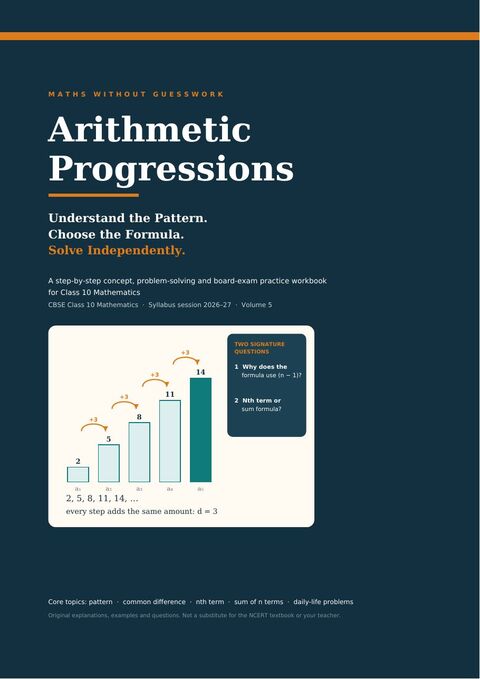
Arithmetic Progressions
Understand why the formula uses (n − 1) and pick term or sum correctly.
₹99
Concept Ebook
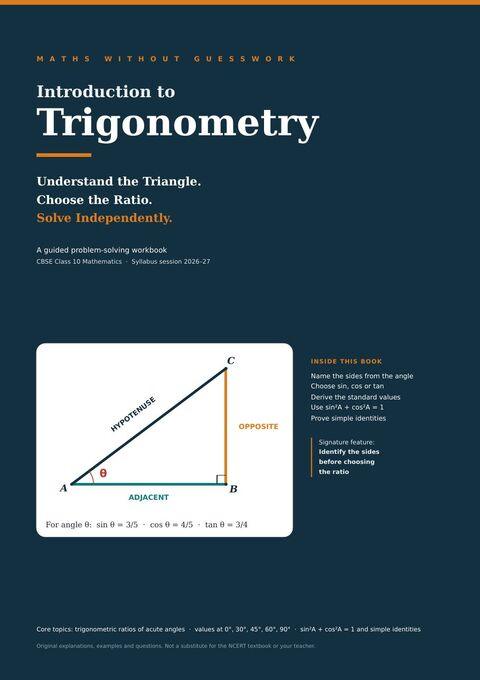
Introduction to Trigonometry
Name the sides correctly before you choose the ratio.
₹99
Get the Triangles workbook and work through it at your own pace.
Buy now · ₹99₹99Buy now